Things you can do to support your community
Some things you can do to support your neighbours and build community resilience — for the pressures we are under now, and for the shocks to come.
Times are becoming more unstable, and our communities are disconnected, insecure and often divided. We are feeling the pressure from the fuel crisis and the ongoing cost of living pressures. Often we struggle alone and it feels hard to reach out for support.
We are being told to blame others in our communities, instead of the big corporations like Coles and Woolworths and the fossil fuel industry who are making record profits.
We can change this. Starting in our streets, we can take steps to build stronger networks of support within our communities to support each other through difficult times.
Together we can build a future where we prioritise people over profit. We can build stronger communities, now and for the future.
Connect your street
Starting to build connection on your street paves the way for the trust and care needed during difficult times. Get in touch with your neighbours and together think about the best way to build connections in your street. This could include organising events like a street bbq, or setting up a group chat so that you can support each other.
Set up or join a community support network
In your street or neighbourhood, connect with your neighbours to offer support to each other for things like: carpooling, sharing grocery runs, sharing excess garden produce or spare ingredients, offering services and support locally, and more.
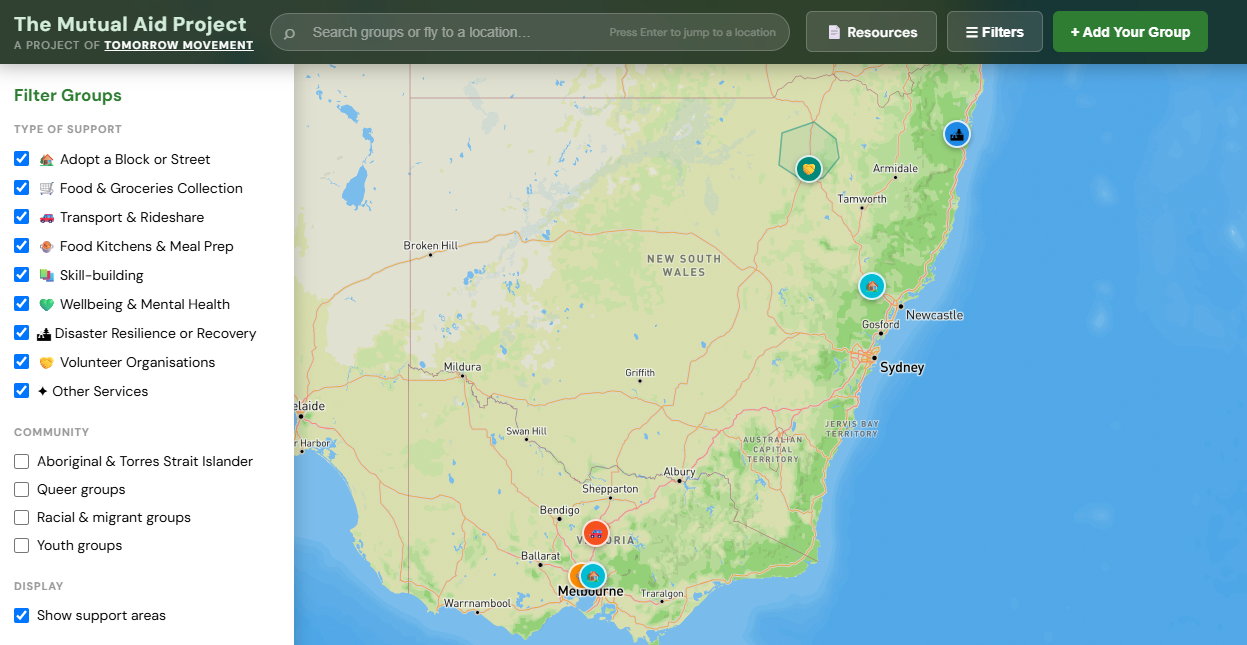
We are registering community support networks as they pop up. Add your group to the map so that others can find it, and pick the kind of support you offer so people can filter for what they need.
Conversation guide
Introduce yourself. Share your name, what house you're at and ask how they are going. If they forget to share their name back, you can ask.
“Hey there! I'm Maddy from number 12 down the road! How are you going today?”
Share your story. Share why you're chatting to your neighbours, what this means to you and why it feels important. Focus on your stories and feelings rather than issues or facts.
“I've been chatting to neighbours because I'm keen to connect more with people on our street. I remember during covid I got to know people on my street, and it helped at a time that I felt really isolated. Recently I've been thinking about ways we can keep connecting as time goes on, because sometimes the world feels a bit crazy and I think it's nice to know we can look out for each other.”
Ask questions and listen. Think about some things you can ask to get to know your neighbour better, like:
- How long have you lived on our street?
- What brought you to this suburb?
- How do you find living here?
- What is your connection to the area?
Respond with some things about yourself to help your neighbour get to know you better.
Ask to stay connected. Invite them to a street bbq, a group chat, or to be involved in another street project.
“It's been really nice to meet you, and I'd love to keep in touch. I'm actually organising a street BBQ on Saturday 11 July if you can join? Can I add you to our street groupchat? We'll use it to organise what food to bring so we don't double up, and to stay connected after.”
Flyers
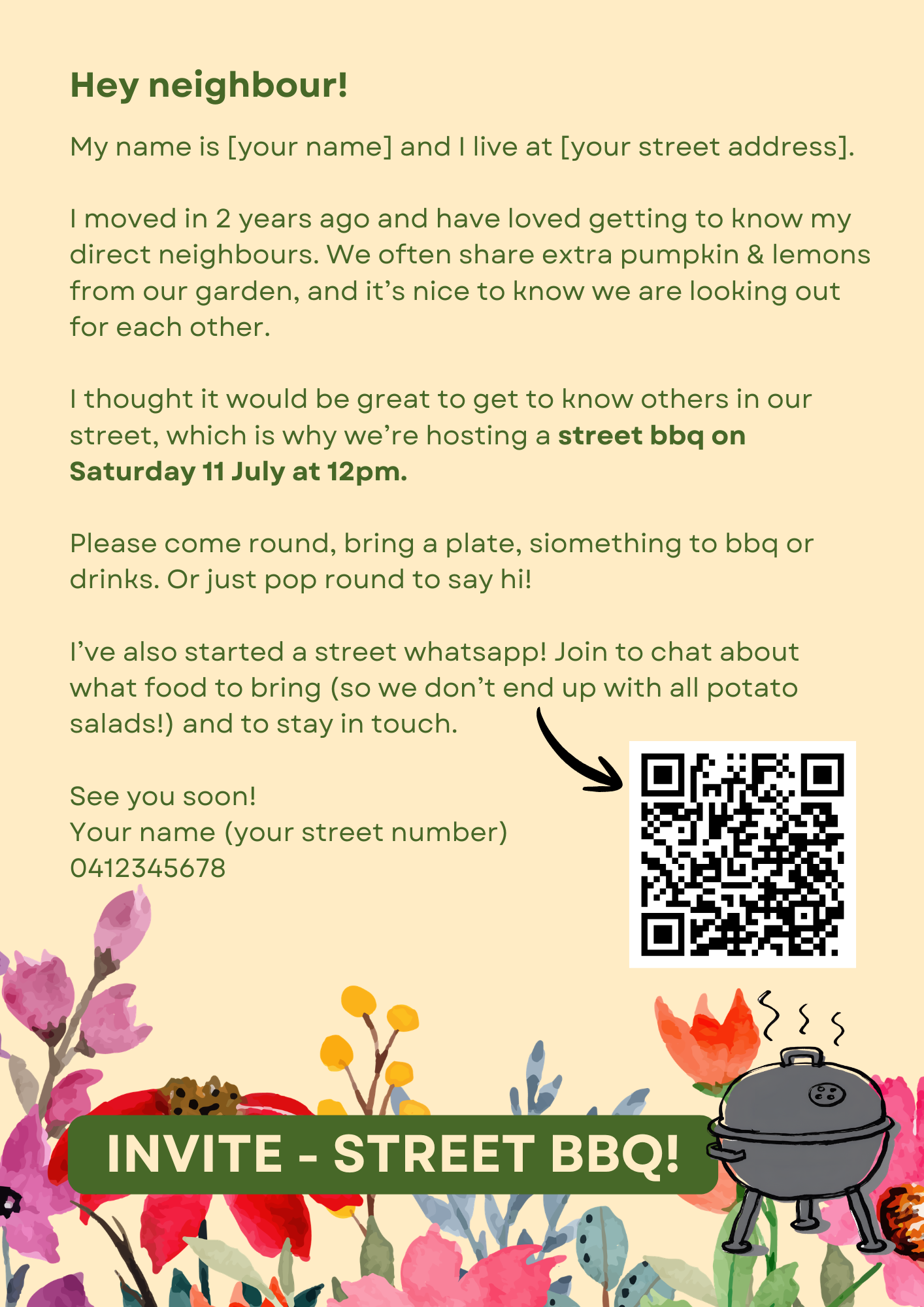
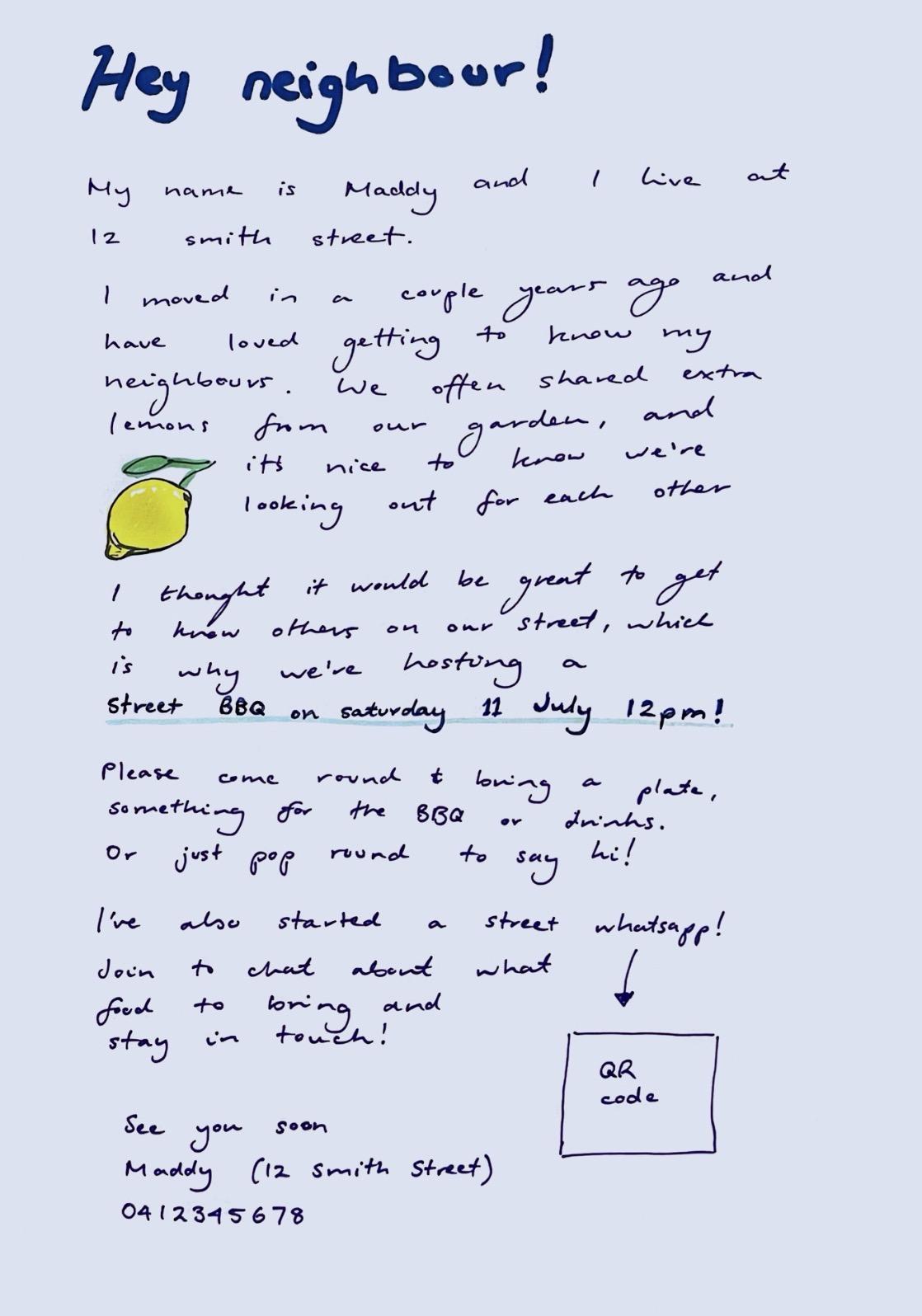
Leave flyers in your neighbours' letterboxes to introduce yourself, invite them to a street event, or invite them to join a community group chat. Printing hand written flyers adds an authentic touch.
Street group chats
What app to use. Use something like WhatsApp — most people have it, it doesn't require having Facebook, and it works on iPhone and Android. WhatsApp communities let you make multiple channels, so separate groups can be made for different topics or events.
Adding people. You can add people directly or send them a link to join. When they join, introduce them or ask them to introduce themselves and their house number. There is an option to share message history so new members are in the loop — note this only works if you add the person directly, not if they join via a link.
Set the chat up. Try to be clear who and what the chat is for. Post an intro message and write a community description.
Community name: ‘27–61 Smith Street’
Description: ‘This chat is for neighbours from 27–61 Smith Street to organise street bbqs, lend tools, share veggies and other ways to support each other! Feel free to add chats to this community for specific things you want to talk about, like a specific event, or gardening advice.’
“Hi everyone, [] here! I thought we could set up a chat as a way to connect with each other. Please add your name and house number in the chat for those who haven't met each other! A few of us also talked about having a street BBQ on the 7th July, and I'd love for you all to join. It'll be at our house, 12 Smith Street. Please bring a plate and something to put on the bbq! Hope to see you there :)”
Managing the chat. You aren't responsible for monitoring everything that happens, but there are things you can do to model the caring behaviour you want to see.
- Not much chat? Offer something. Offer your veggies. Ask to borrow a lawnmower. Share a picture of a nice sunset. Suggest another street bbq.
- Too much chat? Suggest people take it elsewhere — the groups feature lets you make separate chats.
- Harmful messages? Respond in a way that is kind and clear.
“Hey Tim, this comment doesn't feel super kind to me! I would love for us to avoid these kinds of comments so we can make sure our street feels like a caring place. If that doesn't make sense, let's chat!”
Removing someone should be a last resort. If you feel the need to, try to make sure that you or somebody else reaches out to that person. Our communities are for everyone, and we don't want to exclude or abandon people, even if they aren't ready to be in all community spaces.